Buying guide
Best budget-friendly wet cat food in 2026 (that isn't junk)
By Willa Hartley · Senior writer
Last updated
We earn commissions from links on this page, at no cost to you. Our picks stay independent. Prices are indicative and were last checked around publication — they change often, so confirm the current price on the retailer’s site. How we research & rank →
Our picks
Ranked, with the trade-offs
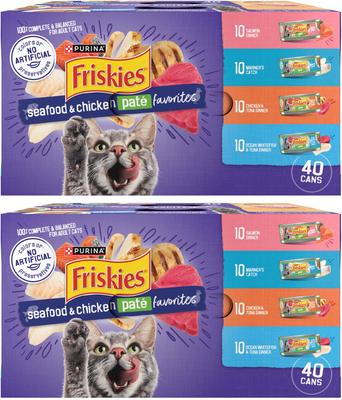
Friskies Seafood Chicken Pate Favorites
from
$65.52
A complete-and-balanced wet food with big 5.5-oz cans and lots of flavor variety.
Pros
- + Big 5.5-oz cans feed multiple cats per can
- + Wide flavor variety that most cats readily eat
Cons
- – Lower-rated by strict nutritional metrics than some other brands
- – Some buyers report dented/damaged cans on delivery
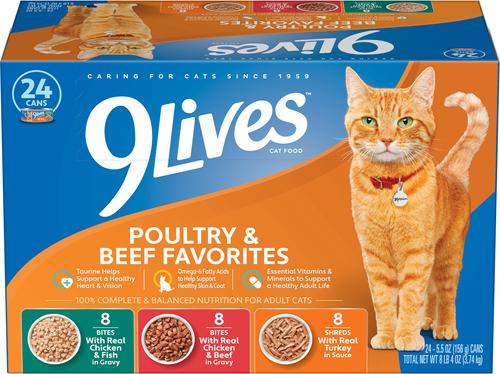
9Lives Poultry Beef Favorites
from
$16.78
Large-can wet food offering complete nutrition with poultry and beef variety flavors.
Pros
- + Big cans and multiple flavors in one pack
- + Widely available at Walmart for easy pickup
Cons
- – Contains by-products and sauces rather than whole meat ingredients
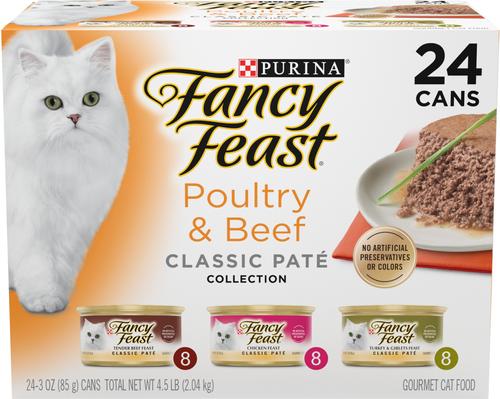
Fancy Feast Classic Poultry Beef Pate
from
$22.86
A gourmet-tasting, low-carb pate in single-serve cans that even very picky cats reliably eat.
Pros
- + Very low-carbohydrate pate good for indoor cats
- + Real chicken, turkey, or beef as the #1 ingredient
- + Highly palatable to finicky eaters
Cons
- – Small 3-oz cans require opening several per day for multi-cat homes
- – Contains meat by-products
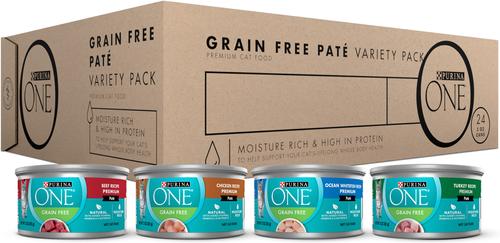
Purina ONE Grain-Free Variety Pack
from
$31.27
A high-protein, grain-free, by-product-free pate from a vet-recommended brand.
Pros
- + Real meat first ingredient with no by-products in this variety pack
- + Backed by a veterinarian-recommended brand
Cons
- – Some owners report recipe inconsistency between batches
- – Small 3-oz cans require frequent opening for multiple cats
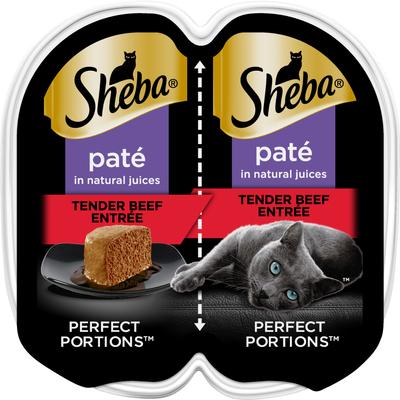
Sheba Perfect Portions Turkey Pate
from
$33.36
Twin-pack snap-and-serve trays that deliver fresh single portions with no messy leftovers.
Pros
- + Portioned twin-pack trays keep every meal fresh with zero waste
- + Smooth pate accepted well by picky cats
- + Decent meat content versus other low-cost brands
Cons
- – Trays can be hard to open, especially for those with arthritis
- – Generates more plastic waste than cans
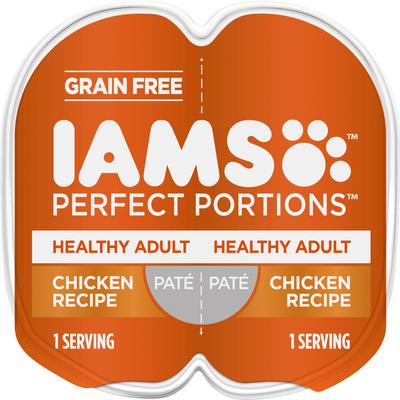
IAMS Perfect Portions Chicken Pate Grain-Free
from
$32
A 4-star-rated, grain-free twin-pack pate with added heart, immune, vision, and coat support nutrients.
Pros
- + Earned a 4-star (above-average) rating from reviewers
- + Fortified with taurine, omegas, and antioxidants
- + Convenient portioned trays usable on their own or as a topper
Cons
- – Single-flavor case offers no variety
- – Trays can be tough to peel open
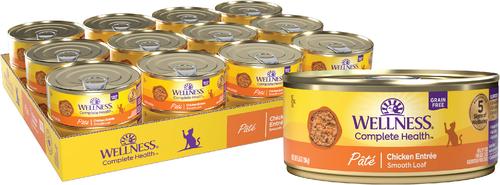
Wellness Complete Health Chicken Grain-Free
from
$67.92
A 'real chicken first, no carrageenan, and very low carbohydrates' option for cats with specific dietary needs.
Pros
- + Real chicken first ingredient with no carrageenan or artificial additives
- + Very low carbohydrate, good for diabetic and sensitive cats
- + Highly rated for ingredient quality
Cons
- – Some cats reject the plain-chicken flavor
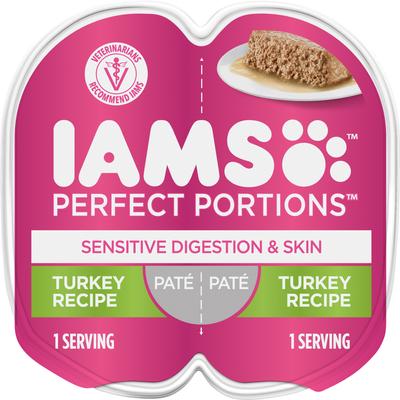
IAMS Perfect Portions Turkey Sensitive
from
$35.04
A targeted twin-pack pate with prebiotics and beet pulp aimed at digestion and skin/coat health.
Pros
- + Prebiotics and fiber blend formulated for digestive support
- + Omega fatty acids target skin and coat health
- + Very low-carb, portioned, grain-free trays
Cons
- – Contains carrageenan in the recipe
- – Single turkey flavor limits variety
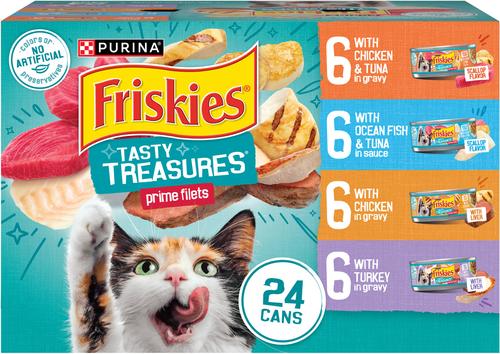
Friskies Tasty Treasures Prime Filets
from
$17
A gravy-and-filets variety pack for cats that prefer saucy textures over pate.
Pros
- + Gravy texture appeals to cats that snub pate
- + Multiple flavors keep mealtime varied
Cons
- – Cats may lick the gravy and leave the chunks
- – Lower ingredient-quality rating than premium foods
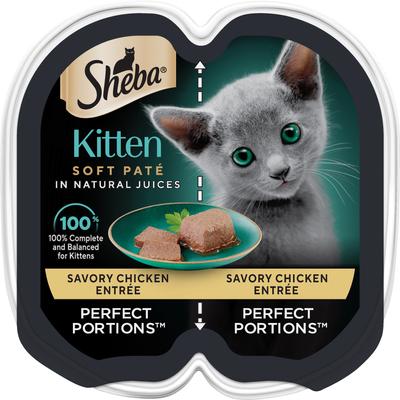
Sheba Perfect Portions Kitten Chicken
from
$30.72
A kitten-specific soft pate with DHA and vitamin E in convenient fresh single-serve trays.
Pros
- + Formulated specifically for kittens with DHA and vitamin E
- + Extra-smooth texture works well for weaning kittens
- + Single-serve trays keep each portion fresh
Cons
- – Trays can be difficult to open
- – Only available in limited flavors
The verdict
Our top picks at a glance
Shoppers seeking variety in wet cat food with multiple flavors in one pack
Picky eaters and single-cat households wanting fresh single-serve portions
Owners wanting a natural recipe with no by-products for all life stages
At a glance
How they compare
| Spec | Top pickFriskies Seafood Chicken Pate Favorites | 9Lives Poultry Beef Favorites | Fancy Feast Classic Poultry Beef Pate |
|---|---|---|---|
| Price | $65.52 | $16.78 | $22.86 |
| Notable | Made without artificial colors or preservatives | — | Grain-free; no artificial colors or preservatives |
| Texture | Pate | Pate/ground in sauce | Smooth pate |
| Can size | 5.5 oz | 5.5 oz | 3 oz |
| Nutrition | 100% complete & balanced for adult cats | 100% complete for kittens & adult maintenance | — |
| Check price → | Check price → | Check price → |
Top 3 of 10 shown — full shortlist above.
Bottom line up front
The best budget wet cat food overall is the Purina ONE Grain-Free Variety Pack. It’s grain-free, lists real meat first with zero by-products, and comes from a brand that runs actual feeding trials, which puts it a notch above most of the pate options in this price range. If you’re feeding multiple cats and need volume over polish, Friskies Seafood & Chicken Pate Favorites in the 5.5-oz case is the better math. For a cat with a sensitive stomach or diabetes risk, skip straight to Wellness Complete Health Pate Chicken Entree.
Budget wet food doesn’t mean bad wet food. Even the cheapest cat food on the market is generally formulated to be complete and balanced, but quality still varies a lot between brands, mostly in the protein source and how much filler rounds out the can. I compared these ten on ingredient lists, carb content, portion format, and what actual owners report about consistency and palatability, not just sticker price.
Why wet food is worth the extra effort over kibble
Cats evolved as desert hunters that get most of their water from prey, not from a bowl. Dry kibble runs around 10% moisture, while wet food is 75-80% water, which matters for kidney function, urinary tract health, and preventing bladder stones over a cat’s lifetime. Vets broadly agree wet food’s moisture content is essential to a balanced diet, not just a nice-to-have. If your budget only stretches to wet food as a topper for one meal a day rather than a full switch, that still helps.
The other advantage is macros. Cats get most of their energy from protein and fat, not carbohydrates, and canned food is naturally lower in carbs than kibble, which lines up better with feline biology. That’s why you’ll see me flag carb percentages below wherever the brand discloses them.
What actually separates a good budget can from a bad one
Before the picks, here’s what to actually check on the label:
- First ingredient should be a named animal protein (chicken, turkey, whitefish), not water or a generic “meat by-product” listed first. Whole, named proteins are ideal, especially for cats with sensitivities.
- Watch for carrageenan. This seaweed-derived thickener, common in wet food, has been linked to increased immune response and digestive issues in some cats. It’s not a dealbreaker in an occasional can, but it’s worth noting if your cat has a sensitive gut.
- Brewers rice as a thickener isn’t great either. It’s been shown to impair taurine absorption, and taurine deficiency is a serious, if rare, health risk for cats.
- Some ultra-cheap formulas include only the minimum protein a cat needs to survive, not thrive. Complete-and-balanced on the label is a floor, not a quality guarantee.
Best overall: Purina ONE Grain-Free Variety Pack
Real meat as the first ingredient, no by-products in this particular variety pack, and it’s grain-free with 0% fillers on the label. It’s backed by a vet-recommended brand that invests in feeding trials, which is a meaningfully higher bar than most budget lines clear. The trade-off is the 3-oz can size, so multi-cat households will be opening a lot of cans a day, and a handful of owners report some batch-to-batch recipe inconsistency. Still, ingredient-for-ingredient, this is the strongest value pick here.
Best for: owners who want a natural recipe with no by-products, across all life stages.
Best for multi-cat homes: Friskies Seafood & Chicken Pate Favorites
The 5.5-oz cans and 48-count case make this the practical choice if you’re feeding three or four cats and don’t want to be opening cans constantly. It’s made without artificial colors or preservatives and is 100% complete and balanced for adult cats, with enough flavor variety that pickier eaters in a multi-cat household usually find something they like. It doesn’t score as well on strict nutritional quality metrics as the pricier options here, and some buyers report dented cans on arrival, so inspect your case when it lands.
Best for: multi-cat homes that need high volume without babysitting portions.
Best for variety on a tight budget: 9Lives Poultry and Beef Favorites
This is the cheapest case in the lineup and still delivers big 5.5-oz cans with a mix of poultry and beef flavors, complete for kittens and adult maintenance. It’s easy to find at Walmart, which matters if you’re already doing a weekly big-box run. The catch is the ingredient list leans on by-products and sauces rather than whole meat, so treat this as an entry-level option rather than one to feed exclusively long-term if you can stretch the budget elsewhere.
Best for: shoppers who want maximum flavor variety at the lowest price point.
Best for picky eaters: Fancy Feast Classic Poultry & Beef Pate Collection
Fancy Feast’s small cans punch above their price in palatability. Real chicken, turkey, or beef leads the ingredient list, it’s grain-free, and it runs about 9-10% carbohydrate on a dry-matter basis, which is low enough to suit most indoor cats. The 3-oz cans mean multi-cat households will go through a lot of them, and it does contain meat by-products, but as a single-cat, fussy-eater solution it’s hard to beat for the price.
Best for: picky eaters and single-cat households that want single-serve freshness.
Best portioned trays: IAMS Perfect Portions Healthy Adult Chicken Recipe Pate
This one earned a 4-star average from reviewers, which is above the norm for this price tier. It’s grain-free, fortified with taurine, omega-3 and 6, calcium, and potassium, and works equally well fed on its own or as a kibble topper. The trade-off is it only comes in one flavor per case, so there’s no variety, and the peel-back trays can be genuinely tough to open if you have limited hand strength.
Best for: owners who want a highly rated, nutrient-fortified pate that doubles as a topper.
Best for sensitive stomachs or diabetic cats: Wellness Complete Health Pate Chicken Entree
If your cat has a sensitive gut or a diabetes diagnosis, this is the pick to start with. Real chicken is the first ingredient, there’s no carrageenan and no artificial additives, and the macros run roughly 39% protein and under 1% carbs on a caloric basis, which is about as close to a cat’s natural prey ratio as a budget-tier can gets. Research suggests high-protein, low-carb canned diets may be the best option for many cats, though more study is still needed. The only real complaint is that some cats reject the plain chicken flavor, so it may take a taste test before committing to a full case.
Best for: diabetic or sensitive-stomach cats that need a high-protein, low-carb, cleaner-ingredient formula.
Best for digestive and skin support: IAMS Perfect Portions Sensitive Digestion & Skin
This targeted formula adds prebiotics and beet pulp for digestive support plus omega-6 and 3 for skin and coat, and it’s impressively low-carb at roughly 3.75% dry matter. It does contain carrageenan despite the digestive-support positioning, which is a bit of a contradiction worth knowing about if your cat is carrageenan-sensitive. Single turkey flavor only, so no variety here either.
Best for: cats with diagnosed sensitive stomachs or skin/coat issues.
Best mess-free format: Sheba Perfect Portions Grain-Free Roasted Turkey Entree
The twin-pack trays snap apart into two 1.3-oz servings, so you feed one half and the other stays sealed and fresh, no plastic wrap and no fridge-smell can. Protein runs a solid ~49.55% dry matter, which is competitive with pricier foods. The trays can be stubborn to open, and they generate more plastic waste per ounce of food than a can does, which matters if that’s a priority for you.
Best for: single-cat households that hate dealing with half-used, refrigerated cans.
Best for gravy lovers: Friskies Tasty Treasures Adult Prime Filets in Gravy
Not every cat wants pate. This variety pack swaps texture for filets in gravy, which appeals to cats that turn their nose up at smoother formulas, and it’s complete and balanced for adults with no artificial colors or preservatives. The known downside of any gravy-style food applies here too: some cats will lick the sauce and leave the meat chunks behind, which can mean they’re not getting full nutrition from the can. Ingredient quality rates below the premium picks on this list.
Best for: gravy-loving cats and owners wanting a large-can alternative to pate.
Best for kittens: Sheba Perfect Portions Kitten Chicken Soft Pate
Built specifically for kittens, with DHA for brain development and vitamin E, in an extra-smooth texture that’s gentle for cats transitioning off milk. Each half-tray portion is 42 kcal, which makes portion control for small kittens or foster litters straightforward. Flavor selection is limited and the trays share the same tough-to-open issue as other twin-pack lines, so factor that in if you’re bottle-feeding or fostering multiples.
Best for: kitten owners and foster homes needing portioned, life-stage-appropriate food.
How to choose among these
Start with how many cats you’re feeding and how often you can shop. Big 5.5-oz cans (Friskies, 9Lives, Wellness) are the better cost-per-ounce math for multi-cat homes; small 3-oz cans and twin-pack trays (Fancy Feast, Purina ONE, Sheba, IAMS) cost more per ounce but waste less if you’ve got a single cat that won’t finish a big can in one sitting.
Then check the label against your cat’s actual needs:
- Sensitive stomach or diabetic risk? Go low-carb and skip carrageenan where you can (Wellness, IAMS Sensitive Digestion).
- Picky eater? Smooth pate with real meat first tends to win over fussy cats (Fancy Feast, Sheba).
- Kitten or senior? Match the life-stage claim on the label, don’t just grab whatever’s cheapest.
- Tight budget, healthy adult cat, no known issues? The bigger multi-cat cans are a reasonable, complete-and-balanced choice.
One industry review found only 6% of wet cat foods fully complied with detailed nutritional guidelines, so no product on a budget shelf, or a premium one, is above double-checking the label yourself.
Can cats eat cheese?
Cats can eat a small amount of cheese occasionally, but most adult cats are lactose intolerant to some degree, so dairy often causes digestive upset. It offers no nutritional benefit a quality wet food doesn’t already provide, so it’s best treated as a rare, tiny treat rather than a regular addition.
Can cats eat eggs?
Fully cooked eggs are safe for cats in small amounts and provide easily digestible protein. Raw eggs carry salmonella risk and contain avidin, which blocks biotin absorption, so stick to scrambled or boiled with nothing added, and keep it an occasional extra rather than a diet staple.
Can cats taste sweet?
No, cats lack the taste receptor gene for sweetness, so they genuinely cannot taste sugar the way humans and dogs can. This is part of why cats are obligate carnivores by instinct as well as biology; they get their energy from protein and fat, not carbohydrates, and sweet flavoring in pet food is really there for human perception, not feline preference.
Can cats eat dog food?
An occasional bite of dog food won’t hurt a cat, but it’s not a substitute for cat food long-term. Dog food lacks adequate taurine, arachidonic acid, and vitamin A in the forms cats need, and a steady diet of it can lead to serious deficiencies over time.
Can dogs eat cat food?
An occasional taste won’t harm a dog, but cat food is formulated with much higher protein and fat levels than dogs need, and regular feeding can lead to weight gain, pancreatitis risk, or GI upset in dogs. It’s not toxic, just not built for a dog’s nutritional profile.
Can cats have peanut butter?
Plain peanut butter in a very small amount is generally non-toxic to cats, but it offers them nothing nutritionally and its thick texture can be a choking hazard or cause it to stick to the roof of the mouth. Always check that it’s free of xylitol, which is toxic to pets, and treat it as a rare novelty, not a food.
Can cats eat bread?
A small piece of plain, fully baked bread won’t harm most cats, but it’s empty carbohydrate calories that displace the protein and fat cats actually need. Raw, unbaked bread dough is genuinely dangerous, as it can expand in the stomach and the yeast can produce alcohol as it ferments, so keep dough well away from cats.
Sources
- 10 Best Wet Cat Foods in 2026, Vet Recommended | PetMD
- The 10 Best Cheap Cat Foods in 2026 - Cats.com
- Which Wet Cat Food Is Best? 9 Vet-Approved Picks | NBC News
- Best Budget-Friendly Wet Cat Food | Cat Food Advisor
- 5 Best Affordable Wet Cat Foods for Savvy Pet Parents
- 10 Best Healthy Canned, Soft, & Wet Cat Food 2026 - Cats.com
- Why Wet Cat Food Is Best: The Healthiest Choice for Your Feline Friend | Acoma Animal Clinic
- Cat Nutrition: Guide to Cat Food Nutrients | PetMD
FAQ
Frequently asked questions
- Is budget wet cat food nutritionally complete?
- Yes, in most cases. Nearly all wet cat foods sold in the US, including budget lines, are formulated to meet AAFCO complete-and-balanced standards for at least one life stage. The difference between cheap and premium formulas usually shows up in protein source quality and filler content, not in whether the food meets minimum nutritional requirements.
- Is pate or gravy-style wet food better for cats?
- Neither is universally better; it comes down to your cat's preference and how thoroughly they eat it. Pate is a uniform blend so cats get consistent nutrition in every bite, while gravy or sauce-based foods let cats lick the liquid and sometimes leave meat chunks behind, which can mean less protein actually consumed.
- How much wet cat food should I feed daily on a budget?
- Most healthy adult cats need roughly 24 calories per pound of body weight daily, which for a typical 10-pound cat is about two to two-and-a-half of the 3-oz cans featured here, or one to one-and-a-half of the larger 5.5-oz cans. Check the calorie count on your specific product and adjust for your cat's activity level and body condition.
- Why is some wet cat food so much cheaper than others?
- Cost differences mostly come down to protein source and processing. Cheaper formulas often use more by-products, fillers like brewers rice, and thickeners like carrageenan, while pricier formulas prioritize named whole meats and skip fillers, which costs more to source and manufacture.