Top 5 of 10 shown — full shortlist above.
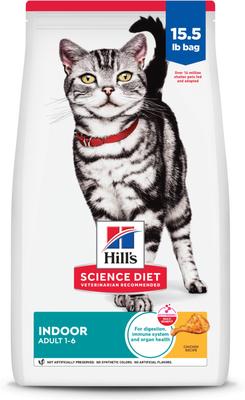
The short version: cats are obligate carnivores, so the best cat food leads with real animal protein, keeps carbohydrates low, and is labeled “complete and balanced” by AAFCO for your cat’s life stage. After comparing the mainstream and premium options on protein, ingredients, life-stage fit, and value, our overall pick for most adult indoor cats is Hill’s Science Diet Adult Indoor Chicken Recipe ($64.99), a science-backed formula that vets consistently recommend. But the right food depends a lot on your cat’s age and quirks, so this guide sorts the picks by who they’re actually for.
We research and compare the cat food market on consistent criteria. We haven’t fed these to a colony of cats; instead, this draws on manufacturer specs, AAFCO and FEDIAF standards, vet consensus, and aggregated owner reviews.
What to look for in cat food
Cats need a lot of protein, a moderate amount of fat, and very little carbohydrate. AAFCO sets the floor at 26% protein for adult maintenance and 30% for growth, but recent research suggests higher is better. Adult cats eating less than 40% protein tend to lose lean body mass over time, and senior cats need even more because their digestion gets less efficient.
A few non-negotiables:
- “Complete and balanced” on the label. This AAFCO term means the food has every required nutrient in the right proportions for a stated life stage. Skip anything that doesn’t say it.
- Taurine and arachidonic acid. Cats can’t make enough of either, unlike dogs. Good commercial foods add taurine; quality animal protein supplies the rest.
- Named animal protein as the first ingredient, not a vague “meat” or a grain.
- Carbohydrate kept low. Ideal is close to zero; under roughly 10% is reasonable for a dry food.
One myth worth clearing up: grain-free is not carb-free. Grain-free recipes often swap in potato, tapioca, peas, or lentils, so the carb count can be similar. Most healthy cats do fine on a regular AAFCO-certified food with grains. Grain-free mainly matters for cats with a confirmed grain sensitivity.
Best overall for adult indoor cats: Hill’s Science Diet Adult Indoor Chicken
Around $64.99 for a 15.5-lb bag. If you have a typical adult indoor cat (ages 1 to 6) and want a dependable everyday food, this is the safe, vet-trusted default. Chicken is the first ingredient, and the indoor-specific fiber is there to ease digestion and cut down on hairballs. Omega-6 fatty acids and vitamin E support skin and coat.
It was the top pick of Chewy’s veterinary panel, which counts for a lot here.
- Pros: Widely recommended by vets, indoor-tuned fiber, skin and coat support.
- Cons: Contains grains and corn-derived ingredients some owners avoid, and it costs more than supermarket kibble.
Not for you if you specifically want grain-free or meat-forward feeding. Look at ORIJEN instead.
Best high-protein kibble: ORIJEN Original Grain-Free
Around $75.99 for a 12-lb bag. This is the meat-forward choice: 90% animal ingredients (chicken, turkey, fish), 40% minimum protein, and no added corn, wheat, soy, or tapioca. The freeze-dried liver coating is a clever touch that wins over fussy cats, and the recipe includes probiotics, omega fatty acids, and added taurine.
At 515 kcal per 8-oz cup, it’s calorie-dense, so measure carefully to avoid overfeeding.
- Pros: Very high protein, picky-eater appeal, well-rounded extras.
- Cons: Premium price, and some owners report stronger-smelling stool on this rich diet.
Worth it if protein content is your priority and the budget allows. If you’re feeding several cats, the per-pound cost adds up fast.
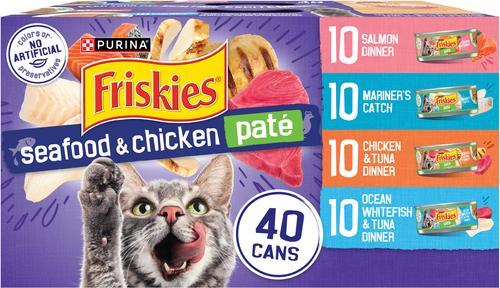
Best budget pick for multi-cat homes: Friskies Seafood & Chicken Pate Variety Pack
A case of 40 5.5-oz cans. For multi-cat households, fosters, and rescues, this is the value play. It’s a smooth pate that cats readily eat, it’s 100% complete and balanced for adults, and it skips artificial colors and preservatives. The wet format also helps with hydration, which matters for cats who don’t drink enough water.
- Pros: Affordable bulk value, palatable, fortified with vitamins, minerals, and taurine.
- Cons: Some recent reviews flag recipe inconsistency and quality-control issues, and cans can arrive dented when shipped in bulk.
This isn’t a premium food and doesn’t pretend to be. But for feeding many mouths without breaking the bank, it does the job.
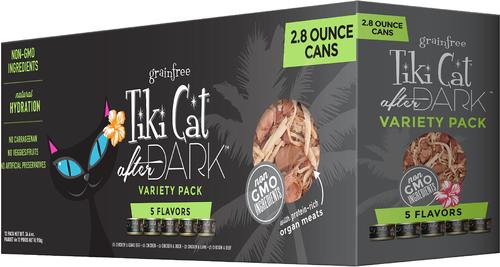
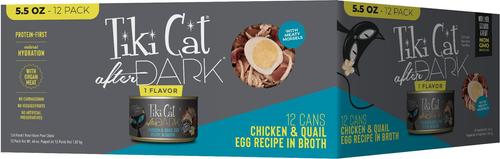
Tiki Cat After Dark is the line to try when nothing else gets eaten. Both are grain-free, very low in carbs, and built around real meat in broth.
- After Dark Variety Pack (12 × 2.8-oz cans): shredded chicken and organ meat in broth, all life stages, zero grains or carbs. The prey-like texture is what converts holdouts.
- Chicken & Quail Egg in Broth (12 × 5.5-oz cans): 129 kcal per can, 82% maximum moisture, roughly 1.2% carbs as-fed, with half a quail egg for novelty. Reviewers describe bowls licked clean in minutes.
Both are pricey, even for premium wet food, and the broth-heavy texture can read as light on meat to some owners. The thin cardboard cases also let cans get dinged in transit. If hydration and tempting a picky cat are your goals, the cost is easier to justify.
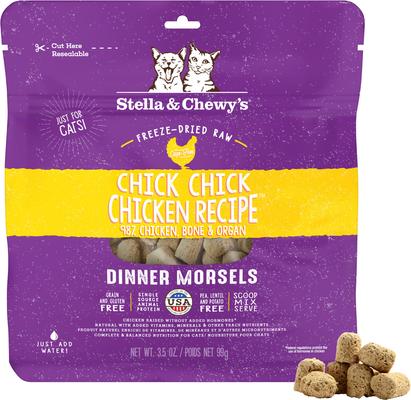
Best raw-style without the prep: Stella & Chewy’s Chick, Chick Chicken
Around $23.99 for a 3.5-oz bag. Freeze-dried raw made with 98% chicken, organs, and bone, at 45% minimum protein. You can serve it dry or rehydrated, and it’s pea-free, lentil-free, and potato-free, which helps cats with sensitivities.
Raw feeding carries real risk. The AVMA and AAHA discourage raw diets because of Salmonella, Listeria, and Campylobacter, and many raw products aren’t even complete and balanced. This product addresses that with High-Pressure Processing to reduce pathogens, third-party testing, and added taurine and probiotics, which is why it makes the list where most raw options wouldn’t.
- Pros: Convenient raw-style nutrition, safety processing, highly palatable.
- Cons: Expensive per ounce, and rehydration adds a step.
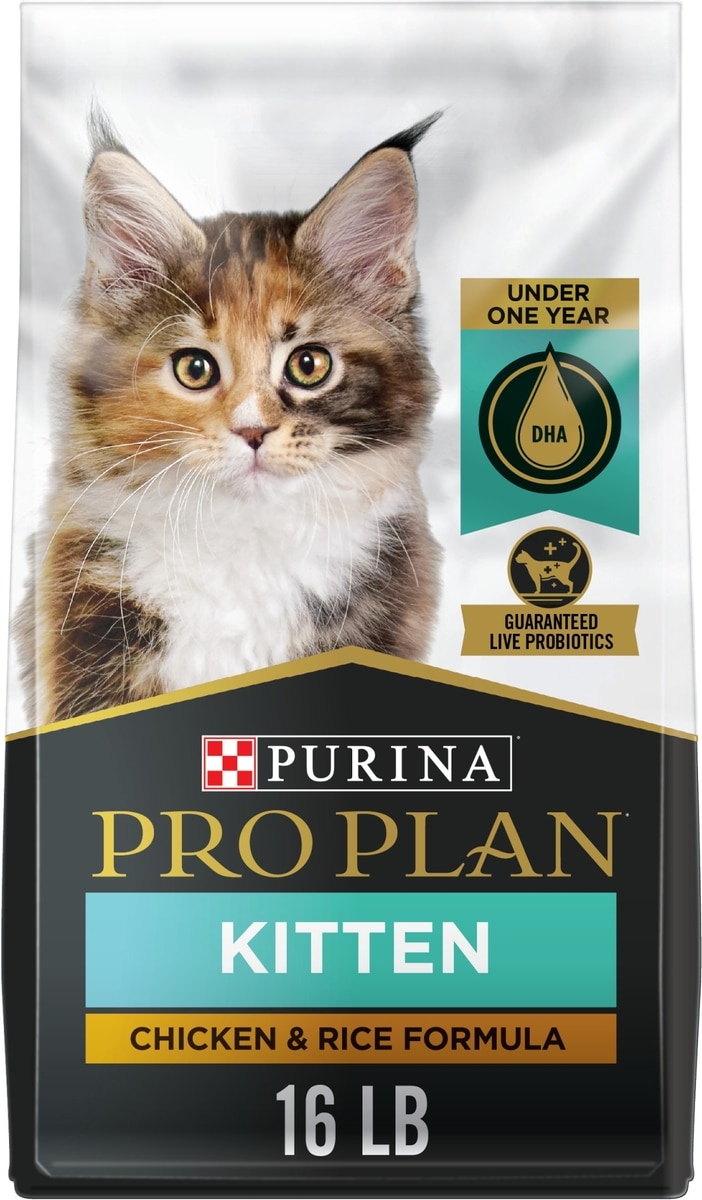
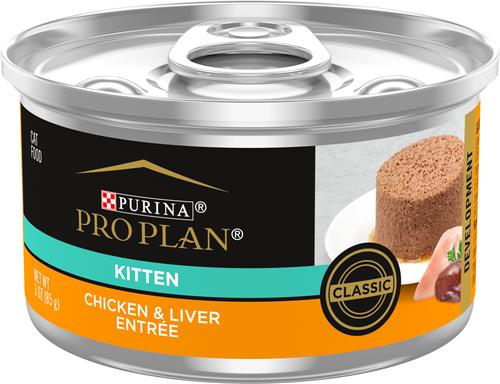
Best for kittens: Purina Pro Plan Kitten Chicken & Rice (plus the wet version)
Kittens need more calories, more protein, and DHA for brain and vision development than adult cats. Feeding adult food to a kitten is a genuine mistake.
- Pro Plan Kitten Chicken & Rice (7-lb dry): real chicken first, DHA, calcium and phosphorus for bones, taurine, vitamin A. It rates 4.7/5 from about 1,539 Chewy ratings and is a frequent favorite among fosters for the value-to-quality ratio.
- Pro Plan Kitten Classic Chicken & Liver Entree (24 × 3-oz cans): a highly digestible pate with DHA and 25 vitamins and minerals. The wet format helps hydration and firms up stools, which matters with young kittens.
Neither is grain-free, and the wet cans contain by-products. The 3-oz cans also mean frequent feeding. For most growing kittens, neither is a real problem.
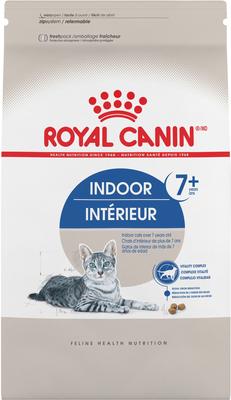
Best for senior cats: Royal Canin Feline Health Nutrition Adult 7+
For cats 7 and older, this formula uses highly digestible proteins and controlled phosphorus to support aging kidneys. The kibble is softer to protect older teeth and gums, and a vitality complex rounds out the nutrition. Chewy’s vet panel recommends it specifically for seniors.
- Pros: Vet-recommended for seniors, highly digestible, phosphorus controlled for renal support.
- Cons: Higher price, and it’s not appropriate for younger adult cats.
One note: older cats often need more protein, not less, so for a healthy senior with no kidney concerns a high-protein adult food may also suit. If your vet has flagged kidney health or digestion, this is a sensible choice.
Best for sensitive stomachs: Hill’s Science Diet Sensitive Stomach & Skin
A 15.5-lb bag of chicken and rice, built for adult cats who get loose stools, vomit often, or have itchy skin. Chicken is the first ingredient, and the recipe is highly digestible to ease upset and improve nutrient absorption. It comes from Hill’s, a brand vets trust heavily.
- Pros: Targeted for digestive and skin issues, vet-trusted brand, gentle and digestible.
- Cons: Not grain-free, and it’s priced above standard adult kibble.
If your cat’s issues persist after a proper food transition, see your vet to rule out an underlying problem.
How much wet food to feed a cat
Most adult cats need roughly 24 to 35 calories per pound of body weight per day, which usually works out to about 2 to 3 standard 3-oz cans, depending on the food’s calorie density. Always check the calories per can and the feeding chart on the label, since they vary widely. A 5.5-oz Tiki Cat After Dark can, for example, is only 129 calories.
For an exact number, ask your vet for your cat’s target daily calories, then divide by the calories per can. Don’t free-feed wet food; portion it into meals.
How long does it take a cat to digest food
A cat’s full digestion typically takes around 10 to 24 hours, with food moving out of the stomach in a few hours and finishing through the intestines over the next day or so. Wet food tends to pass faster than dry. This is partly why splitting meals and not overfeeding matters: cats are poor at self-regulating, and constant access to dry food is a common cause of obesity.
When you switch foods, transition gradually over 7 to 10 days, mixing increasing amounts of the new food into the old, so the digestive system adapts and you avoid stomach upset.
How to choose, in short
Match the food to your cat’s life stage first, then their needs:
- Adult indoor cat, no issues: Hill’s Science Diet Adult Indoor, or ORIJEN if you want high protein and grain-free.
- Kitten: Pro Plan Kitten dry, paired with the wet version for hydration.
- Senior (7+): Royal Canin 7+, especially with vet-flagged kidney or digestion concerns.
- Sensitive stomach or skin: Hill’s Sensitive Stomach & Skin.
- Picky eater: Tiki Cat After Dark, or the freeze-dried Stella & Chewy’s.
- Multiple cats on a budget: Friskies variety pack.
Whatever you pick, confirm it’s labeled complete and balanced for the right life stage, store dry food sealed and away from heat and humidity (fats oxidize and lose nutrients once exposed to air), and adjust portions as your cat ages.
Sources