Buying guide
Small Cat Food Reviews: Best Picks for Every Budget and Diet Need
By Willa Hartley · Senior writer
Last updated
We earn commissions from links on this page, at no cost to you. Our picks stay independent. Prices are indicative and were last checked around publication — they change often, so confirm the current price on the retailer’s site. How we research & rank →
Our picks
Ranked, with the trade-offs
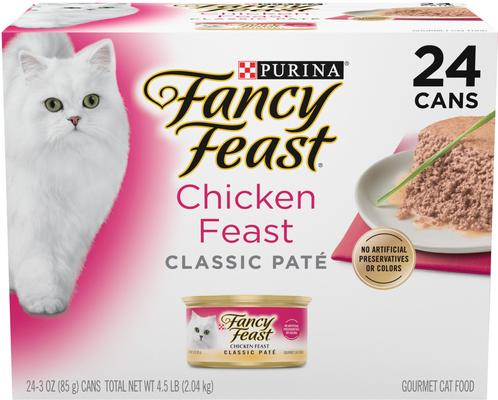
Fancy Feast Classic Chicken Pate
from
$22.86
A low-carb grain-free pate that wins over even picky eaters.
Pros
- + Grain-free and low in carbohydrates, with real chicken as the #1 ingredient
- + Widely loved by picky eaters and easy to find in stores and online
Cons
- – Contains meat by-products and added flavors that some owners prefer to avoid
- – Small 3-oz cans mean frequent feeding for multi-cat homes
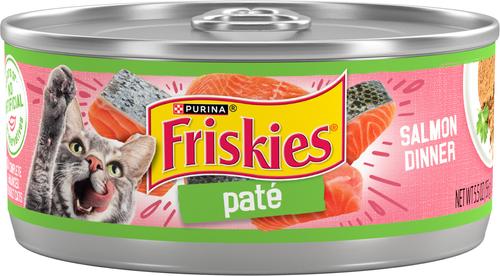
Friskies Classic Salmon Pate
from
$20.88
A pate with larger cans, ideal for feeding many cats or splitting meals.
Pros
- + Large 5.5-oz cans suit multi-cat homes
- + Smooth pate is a reliable favorite, useful for hiding medication
- + Made in Purina-owned U.S. facilities to or above industry standards
Cons
- – Some owners report shrinking portions and crumbly (vs. smooth) texture
- – Grain-inclusive and not formulated for kittens
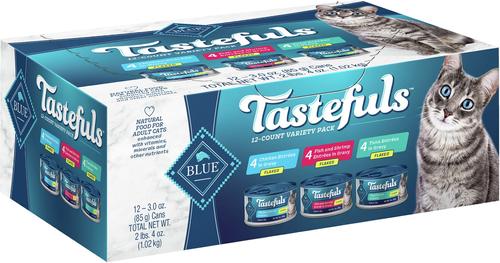
Blue Buffalo Tastefuls Flaked Variety
from
$14.48
A natural flaked-in-gravy variety pack free of common fillers for flavor rotation.
Pros
- + Variety pack lets you rotate flavors to keep mealtime interesting
- + Free from by-product meals, corn, wheat, soy and artificial flavors/preservatives
- + Cooked in gravy with real meat and fish that cats enjoy
Cons
- – Gravy-style recipes tend to be higher in carbs than plain pates
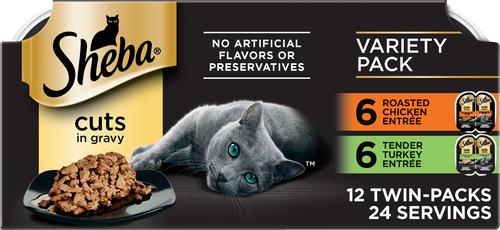
Sheba Perfect Portions Gravy Trays
Single-serve twin-pack trays that eliminate leftovers and storage hassle.
Pros
- + Peel-open twin trays give exact portions with no can to refrigerate
- + Grain-free recipes with several protein options
- + Smaller portions reduce food waste for single-cat households
Cons
- – Higher cost per ounce than standard cans
- – Small servings can be inconvenient for multi-cat feeding
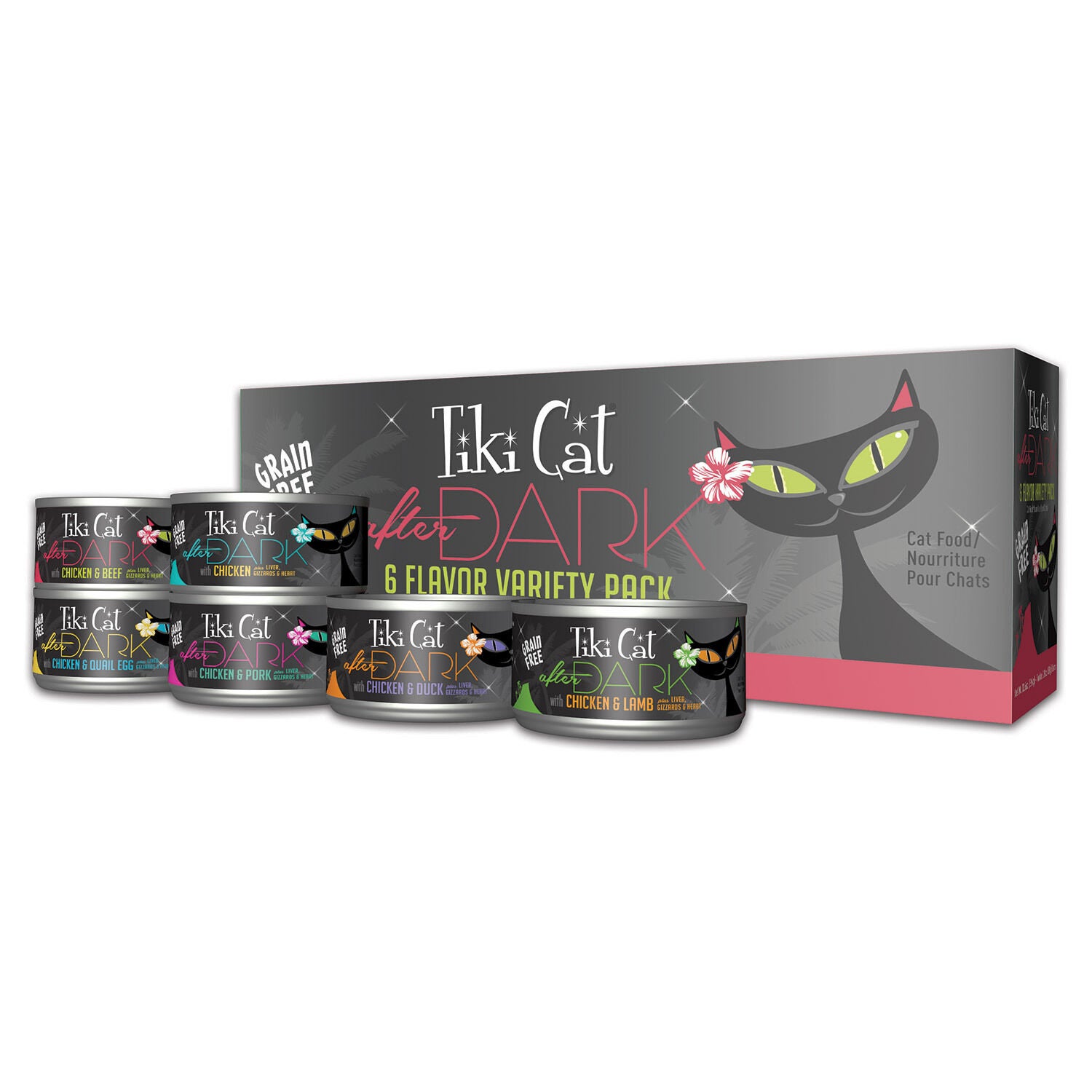
Tiki Cat After Dark Variety
from
$26.11
High-protein, grain-free shredded meat and organ recipes that mimic a prey diet.
Pros
- + Very high in animal protein with real meat and nutrient-dense organ meat
- + Moisture-rich broth helps cats stay hydrated
- + Variety of recipes appeals to picky eaters and rotates nutrients
Cons
- – Owners report cans arriving dented due to thin cardboard packaging
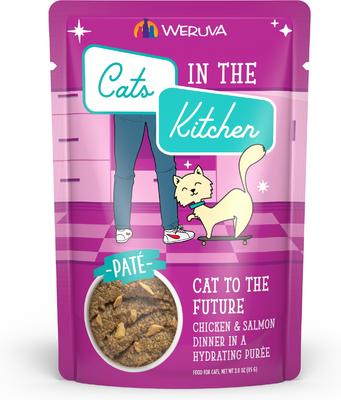
Weruva Cats in the Kitchen
from
$22.68
Human-grade-style shredded recipes with clean labels and no carrageenan.
Pros
- + Very high protein (66–75% dry matter) with visible real shredded meat
- + Free of carrageenan, a thickener linked to digestive inflammation
- + Short, transparent ingredient lists suit sensitive cats; no major recall history
Cons
- – Includes potato starch and plant oils that aren't ideal for obligate carnivores
- – Requires careful portioning to prevent overfeeding due to high moisture content in broth
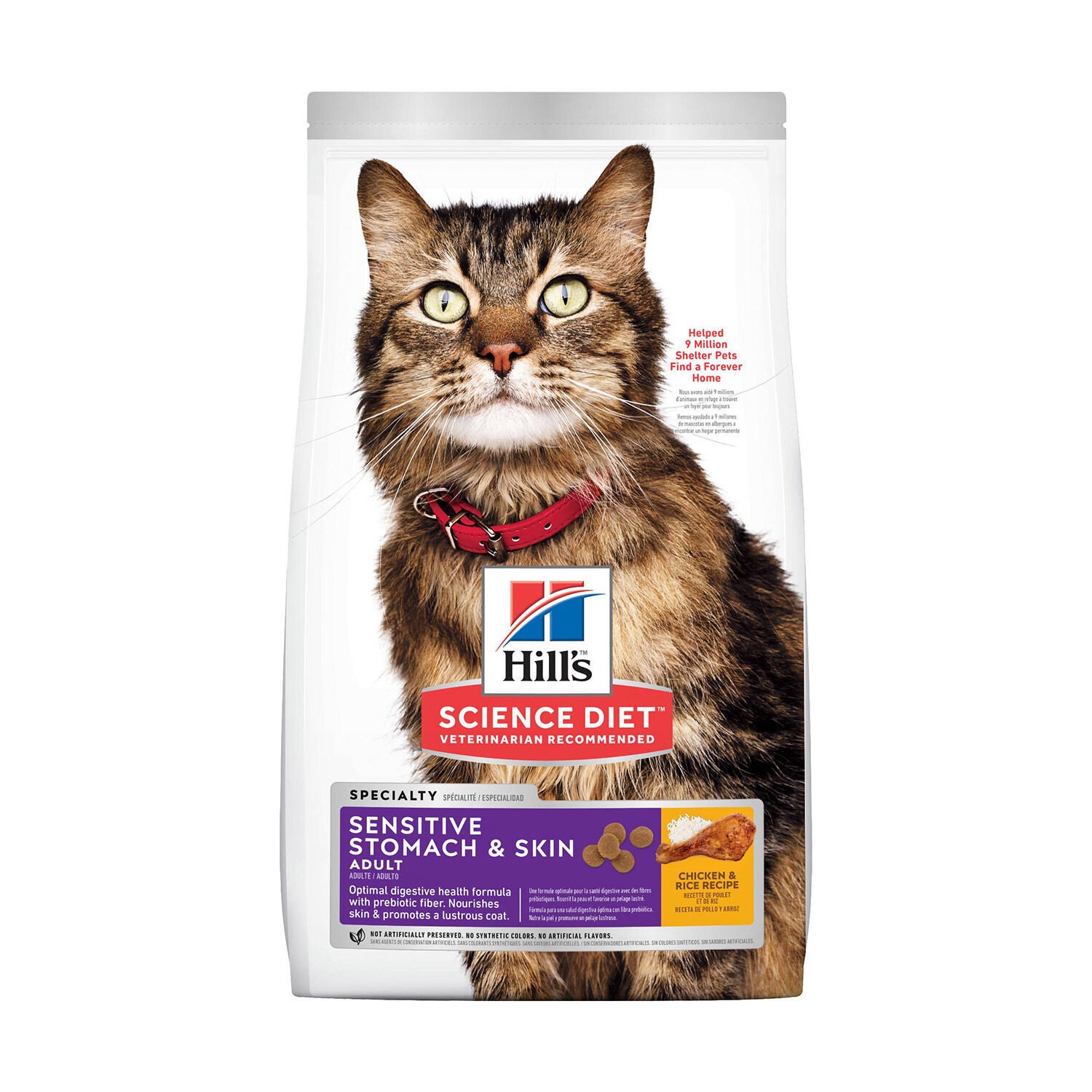
Hill's Science Diet Sensitive Stomach Chicken Rice
from
$67.99
Vet-recommended dry food targeting digestion and skin health with prebiotic fiber.
Pros
- + Prebiotic fiber and highly digestible formula support sensitive stomachs
- + Vitamin E and omega fatty acids noticeably improve skin and coat
- + Hill's is the #1 vet-recommended brand with strong research backing
Cons
- – Higher upfront cost than grocery dry foods
- – Dry-only feeding requires ensuring the cat drinks enough water
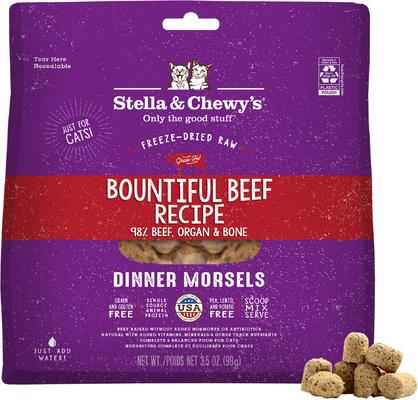
Stella & Chewy's Chicken Freeze-Dried Morsels
from
$10.97
Convenient freeze-dried raw morsels with 98% meat, organs and bone for picky or sensitive cats.
Pros
- + 98% meat, organs and bone delivers high, species-appropriate protein
- + Can be served dry, crumbled as a topper, or rehydrated for moisture
Cons
- – Best results require rehydration, adding a small prep step

Smalls Fresh Cat Food
Human-grade fresh food delivered frozen, top-ranked for ingredient quality.
Pros
- + Human-grade ingredients with protein-rich, low-carb recipes
- + Every batch is pathogen-tested before shipping
Cons
- – Requires freezer storage and overnight thawing before feeding
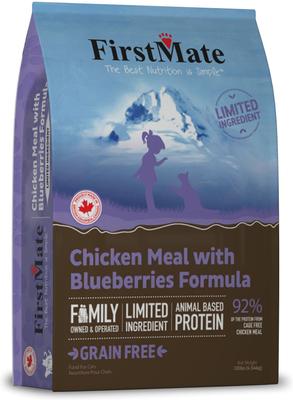
FirstMate Chicken Blueberries Limited Ingredient
from
$44.99
A high-protein, limited-ingredient kibble built around a single animal protein.
Pros
- + Single animal-protein source improves digestibility and reduces sensitivity risk
- + High 40% crude protein on a dry matter basis
- + Top-rated overall pick among dry foods by Cats.com testers
Cons
- – Single-protein focus offers less flavor variety for cats that crave rotation
The verdict
Our top picks at a glance
Multi-cat and feral-feeding households, and cats that only eat pate.
Owners wanting a natural wet food and cats that get bored of one flavor.
Single-cat homes and owners who want fresh, no-waste portioning.
At a glance
How they compare
| Spec | Top pickFancy Feast Classic Chicken Pate | Friskies Classic Salmon Pate | Blue Buffalo Tastefuls Flaked Variety |
|---|---|---|---|
| Price | $22.86 | $20.88 | $14.48 |
| Diet | Grain-free, no artificial colors or preservatives | No artificial colors or preservatives | — |
| Form | Wet pate, 3-oz cans | Wet pate, 5.5-oz cans | Flaked in gravy, 3-oz cans |
| Pack size | Case of 24 | Case of 24 | — |
| Calories | — | ~180 kcal per 5.5-oz can | ~77–87 per can |
| Check price → | Check price → | Check price → |
Top 3 of 10 shown — full shortlist above.
Finding a cat food that your cat will actually eat — and that holds up nutritionally — is harder than it sounds. Cats are obligate carnivores with specific requirements for taurine, arginine, and animal-based protein that no plant-heavy diet can cover. After comparing specs, manufacturer sourcing claims, AAFCO compliance, and aggregated owner reviews across ten options, here’s the honest breakdown.
Top pick overall: Weruva Cats in the Kitchen for owners who want clean labels and high protein. For budget buyers, Fancy Feast Classic Pate is the most defensible choice at ~$0.32/oz.
Fancy Feast Classic Pate Chicken Feast — best budget pick
Price: $21.12 for a case of 24 (3-oz cans), roughly $0.32/oz
Fancy Feast Classic Pate is the easiest recommendation for budget-conscious owners because it punches above its price class nutritionally. Real chicken is the first ingredient, it’s grain-free, and the dry-matter carb content sits around 10.45% — respectable for a grocery-aisle brand. Picky cats tend to accept the smooth pate texture readily, which is why it shows up constantly in owner forums as a fallback food.
The trade-offs are real, though. The formula includes meat by-products and added flavors, which aren’t problems for most cats but matter to some owners. Three-ounce cans also go fast in multi-cat homes — you’ll be opening a lot of them.
- Pros: ~$0.32/oz, grain-free, low-carb, picky-eater friendly, widely available
- Cons: meat by-products and added flavors; small cans add up quickly for multiple cats
Not for: owners who want clean, single-protein labels or feed three or more cats.
Friskies Classic Pate Salmon Dinner — best for multi-cat or feral feeding
Price: Not listed (check current price)
If you’re feeding several cats or supporting a feral colony on a tight budget, Friskies’ 5.5-oz cans give you more food per open. At roughly 180 kcal per can, each serving goes further than the 3-oz Fancy Feast alternative. The pate is smooth enough to hide medications, which caregivers often cite as a practical bonus.
The downsides are worth knowing. Some buyers have reported shrinking portion sizes and occasional crumbly texture rather than a consistent smooth pate. It’s grain-inclusive and not formulated for kittens, so it doesn’t fit every household.
- Pros: Large 5.5-oz cans, strong value for volume feeding, made in Purina-owned U.S. facilities, good for medication hiding
- Cons: grain-inclusive; texture can vary batch to batch; not suitable for kittens
Not for: owners wanting grain-free or single-life-stage kitten food.
Blue Buffalo Tastefuls Flaked Variety Pack — best mid-tier wet food
Price: Not listed (check current price)
Blue Buffalo Tastefuls slots in as a solid mid-tier option for owners who want something cleaner than Friskies without paying Weruva prices. The variety pack — Tuna, Chicken, and Fish & Shrimp — lets you rotate flavors, which helps cats that bore easily and may support broader nutrient intake over time.
The formula is free of by-product meals, corn, wheat, soy, and artificial flavors, and the 78% moisture content supports hydration. That said, gravy-style recipes tend to carry more carbs than straight pates, which matters if you’re managing weight or diabetes. It’s also pricier per can than Friskies or Fancy Feast.
- Pros: Flavor variety, no by-product meals or common fillers, high moisture, real meat and fish
- Cons: higher cost than grocery brands; gravy format means higher carbs than pates
Not for: cats on strict low-carb diets or owners stretching a tight budget.
Sheba Perfect Portions Cuts in Gravy Twin-Pack Trays — best for single-cat homes
Price: Not listed (check current price)
Sheba’s peel-open twin trays are genuinely clever for single-cat households. Each 2.6-oz twin tray splits into two servings, so you use half and snap the other half closed — no can opener, no separate storage container, no refrigerating an open can. For owners who hate food waste, that’s a meaningful quality-of-life improvement.
Grain-free options are available, and protein choices span chicken, salmon, turkey, and whitefish with tuna. The catch is cost per ounce: you pay a convenience premium compared to standard cans. And if you have two or more cats, you’ll burn through trays quickly and lose the value proposition.
- Pros: No-waste portioning, peel-and-serve convenience, grain-free options, multiple protein choices
- Cons: higher cost per ounce than cans; inconvenient for multi-cat homes
Not for: multi-cat households or budget-focused buyers.
Tiki Cat After Dark Variety Pack — best high-protein wet food
Price: $26.11 for a case of 12 (2.8-oz cans)
Tiki Cat After Dark is one of the more carnivore-aligned wet foods on this list. The recipes use real shredded chicken plus organ meats — liver, heart — in a moisture-rich broth. Organ meats are nutrient-dense and closer to what a cat’s prey-based diet would include, and the broth format helps cats stay hydrated, which matters given that dry food has been linked to higher rates of feline lower urinary tract disease.
The six-recipe variety pack suits picky eaters and makes rotation easy. At $26.11 for 12 cans, though, it’s noticeably more expensive than mainstream brands. Owners have also flagged thin cardboard packaging leading to dented cans in transit, which is a legitimate shipping frustration.
- Pros: High animal protein, organ meats, moisture-rich broth, variety of six recipes, non-GMO and suitable for all life stages
- Cons: premium price; thin packaging leads to transit damage
Not for: budget buyers or owners who need large-quantity, low-cost feeding.
Weruva Cats in the Kitchen / Classic Wet Cat Food — best clean-label wet food
Price: ~$0.35–$0.68/oz (check current price)
Weruva is the pick for owners who read ingredient lists carefully. Dry-matter protein runs 66–75%, which is exceptional, and the short ingredient lists show real shredded meat without carrageenan — a thickener that has been linked to digestive inflammation in some research. Weruva has no major recall history, which adds confidence given how many premium brands have had issues.
The food is made in human-food-standard facilities, and the visible chunks of meat give it a transparency that cats seem to respond to. The price, though, is genuinely high: sole-feeding an adult cat could cost $3.50–$6.00 per day depending on the recipe. Some recipes also include potato starch and plant oils, which aren’t ideal for obligate carnivores who thrive on animal fat and protein.
- Pros: 66–75% dry-matter protein, no carrageenan, clean labels, no major recall history, shredded whole-meat texture
- Cons: expensive for sole feeding; some recipes contain potato starch and plant oils
Not for: owners on a budget or cats that prefer smooth pate textures.
Hill’s Science Diet Adult Sensitive Stomach & Skin Chicken & Rice Dry Cat Food — best for sensitive digestion
Price: $67.99 for a 15.5-lb bag
Hill’s Science Diet is the recommendation when a cat has documented digestive or skin issues and a vet is involved in the food conversation. It’s the number-one vet-recommended brand in the U.S., and this specific formula includes prebiotic fiber, vitamin E, and omega-3 and -6 fatty acids targeting coat and skin health. The formula is built around digestibility rather than just a nutrient label.
The main caveat with any dry-only feeding plan is water intake. Cats fed exclusively dry food replace only about half the daily water they’d get from canned diets, which increases the risk of urinary tract problems over time. If you use this kibble, supplementing with wet food or a water fountain is worth considering.
- Pros: Prebiotic fiber, highly digestible, vet-backed research, omega fatty acids for skin and coat, 29 key nutrients
- Cons: higher upfront cost than grocery kibble; dry-only feeding needs attention to hydration
Not for: cats with diagnosed urinary issues or owners opposed to rice/grain-inclusive formulas.
Stella & Chewy’s Freeze-Dried Raw Dinner Morsels, Chicken Recipe — best freeze-dried raw
Price: Not listed (check current price; available in 1, 3.5, 8, and 18-oz bags)
Stella & Chewy’s takes raw nutrition and makes it safer and more convenient. The morsels are 98% chicken, organs, and bone, with taurine and probiotics added. High-Pressure Processing (HPP) is used to reduce pathogen risk — an important step given that the AVMA and AAHA both caution against raw diets specifically because of Salmonella, Listeria, and Campylobacter contamination risks.
You can serve these dry as a complete meal, crumble them over kibble as a topper, or rehydrate with water for extra moisture. The single-protein, pea-lentil-potato-free formula suits cats with food sensitivities. The price per ounce is high compared to canned food, and rehydration — though simple — adds a step that not everyone wants in their routine.
- Pros: 98% meat/organs/bone, HPP safety process, flexible serving methods, good for allergic or sensitive cats
- Cons: expensive per ounce; rehydration recommended for best results
Not for: owners wanting a fully hands-off feeding routine or those on a tight budget.
Smalls Fresh Cat Food — best human-grade fresh food
Price: Subscription-based (sampler available; check current pricing)
Smalls occupies its own category. It’s fresh, human-grade food delivered frozen — sourced from the U.S. and Canada, made in New Jersey, and pathogen-tested before shipping. The customizable subscription quiz matches recipes to your cat’s weight, age, and activity level, and a 30-day money-back guarantee takes some risk out of the trial.
For cats with chronic health issues, food sensitivities, or owners who simply want the highest reasonable standard of nutrition, Smalls is the most defensible choice. The obvious barriers are cost and logistics: it’s significantly more expensive than any canned food on this list, requires freezer space, and needs overnight thawing before feeding.
- Pros: Human-grade, protein-rich, low-carb, pathogen-tested, customizable, 30-day guarantee
- Cons: most expensive option here; requires freezer storage and advance thawing
Not for: owners without freezer space, those who want the simplicity of a shelf-stable product, or anyone on a tight budget.
FirstMate Chicken Meal with Blueberries Limited Ingredient Dry Cat Food — best limited-ingredient kibble
Price: Not listed (check current price)
FirstMate is a strong pick for cats with confirmed food sensitivities who need dry food for practical reasons. The formula uses cage-free chicken as the sole animal protein, which simplifies diagnosis if a sensitivity reaction occurs. Dry-matter protein sits at 40% with crude fat around 18% — solid numbers for a dry food. Cats.com rates it as a top overall pick among dry foods.
Like any limited-ingredient food, it’s a tool for managing sensitivities, not a magic solution. It costs more than mainstream kibble, and if your cat craves variety, a single-protein diet won’t offer any rotation.
- Pros: Single animal protein, 40% dry-matter protein, clean limited-ingredient list, top-rated by independent reviewers
- Cons: premium price; no flavor variety for cats that want rotation
Not for: cats that need multi-protein diets or owners who want one food for several cats with different preferences.
How to choose the right cat food
A few principles that hold across every budget and preference:
Wet food is worth prioritizing. Cats fed dry food exclusively drink only about half the water they’d get from a canned diet. Lower moisture intake is directly associated with feline lower urinary tract disease. If you’re using dry food, pair it with at least some wet food or a running water fountain.
Carbs below 10% is the target for wet foods. Cats are obligate carnivores — they can’t efficiently process high carbohydrate loads, and approximately 61% of U.S. cats are overweight or obese. Low-carb wet foods are the single biggest nutritional lever most owners can pull.
AAFCO statement matters. Look for “complete and balanced” on the label, verified either through feeding trials (the gold standard for real-world digestibility) or nutrient-profile formulation. A food without this statement isn’t appropriate as a sole diet.
Match the life stage. Kittens need at least 30% dry-matter protein (AAFCO minimum for growth/reproduction). Adult cats need a maintenance formula. “All life stages” foods meet kitten requirements but aren’t as precisely tailored to adults.
Budget picks are not automatically worse. Fancy Feast Classic Pate is grain-free with real chicken as the first ingredient at $0.32/oz. More expensive doesn’t automatically mean better — but you do need to check the actual nutrient profile, not just the marketing language. “Premium” is an unregulated term with no legal nutritional standard behind it.
If your cat has specific health conditions — urinary issues, skin problems, inflammatory bowel disease — get a vet’s input before switching foods. No online guide replaces a diagnosis.
Sources
- Nutritional Requirements of Small Animals - Management and Nutrition - Merck Veterinary Manual
- The nutritional requirements of cats & Calculator — The Little Carnivore
- Proper Nutrition for Cats - Cat Owners - MSD Veterinary Manual
- The Unique Nutritional Requirements of the Cat: A Strict Carnivore | Veterian Key
- Dietary intake of amino acids and vitamins compared to NRC requirements in obese cats undergoing energy restriction for weight loss
- Phenylalanine requirements using the direct amino acid oxidation technique, and the effects of dietary phenylalanine on food intake, gastric emptying, and macronutrient metabolism in adult cats
- YOUR CAT’S NUTRITIONAL NEEDS A Science-Based Guide For Pet Owners
- Cat Nutrition: Guide to Cat Food Nutrients | PetMD
FAQ
Frequently asked questions
- How tall should a cat food bowl be?
- Most cats eat most comfortably from a shallow bowl elevated 2–4 inches off the ground. Flat-faced (brachycephalic) breeds like Persians often do better with a very shallow, wide dish at a slight angle, while taller cats may benefit from bowls elevated up to 4–6 inches to reduce neck strain. The key is that your cat can eat without pressing its whiskers against the sides, which causes stress known as whisker fatigue.
- Is cat food bad for dogs?
- Occasional small amounts won't harm most healthy dogs, but cat food is not appropriate as a regular diet for dogs. Cat food is formulated with much higher protein and fat levels to meet feline nutritional requirements, and over time this can contribute to weight gain, pancreatitis, and digestive upset in dogs. Dogs and cats have different nutrient needs, so each species needs food designed for them.
- How long does it take a cat to digest food?
- A cat's digestive transit time is typically 10–24 hours, though this varies by the cat's age, health, and the type of food eaten. Wet food generally moves through more quickly than dry kibble, partly because of its higher moisture content. Kittens and senior cats may have slightly different transit times than healthy adults.
- What's the difference between 'complete and balanced' and 'complementary' cat food?
- A 'complete and balanced' label means the food meets AAFCO nutrient profiles for a specific life stage and can serve as a cat's sole diet. 'Complementary' or 'supplemental' foods — including many treats and meal toppers — don't meet those minimums and must be fed alongside a complete food. Always check the AAFCO statement on the label before using a food as your cat's primary diet.